The distinguished New York organ builder Henry Erben (1800-1884) was America’s most prolific and most famous organ builder through most of the 19th century. Typical of American organs during that era, Erben’s instruments were influenced by the English Romantic style, characterized by breadth and smoothness of tone via wide scaling and closed-toe, heavily nicked voicing. However, unlike most of his contemporaries, Erben typically did not include multiple 8-foot Diapasons in the same division, although his frequent inclusion of a Dulciana functioned as a 2nd Diapason. Additionally, his English-style mixtures invariably included a third-sounding rank, along with the standard octaves and fifths. Following English practice, the Sesquialtera and Cornet are intended to be used not only as part of a solo registration, but also as low-pitch mixtures. Typical of the period, this organ is tuned to approximately A450, about a quarter tone higher than modern Concert Pitch.
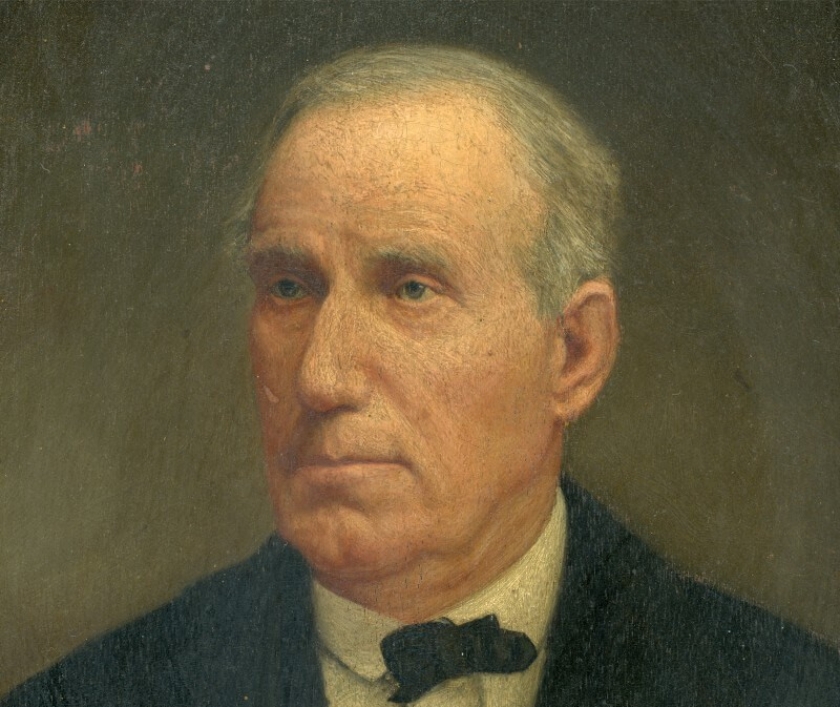
portrait of Henry Erben
Dating the organ
St. Patrick’s in Hartford, Connecticut was destroyed by fire in 1875, then completely rebuilt on the same site. Henry Erben was contracted to build a new organ for the rebuilt church, which at that time was the cathedral for the Roman Catholic Diocese of Hartford. The organ’s actual date of construction is 1876 and was hailed by the Hartford Daily Courant as “an instrument of magnificent volume and of perfect tone…a very superior instrument in all respects”. Its dedicatory recital was given on September 21, 1876 by Professor Richard O. Phelps (1847-1917), who was a well-known organist at Hartford’s Windsor Avenue Congregational Church. This was followed by nightly concerts by various other Hartford organists.
From Hartford Daily Courant, September 22, 1876:
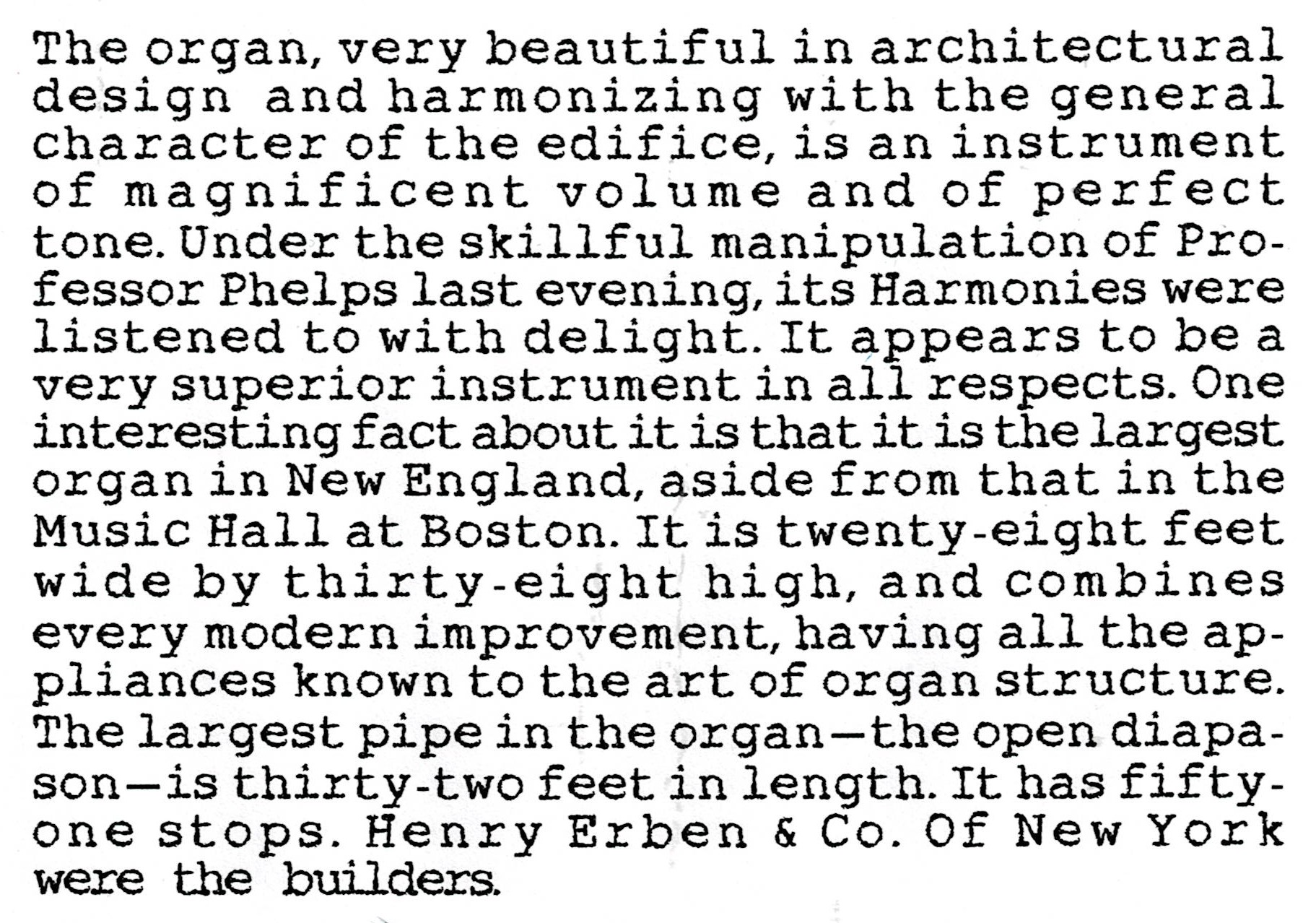
One news article stated that the organ had 50 stops, another stated 51 stops (which is not possible, so certainly was supposed to say 40 or 41 ranks, i.e. individual sets of pipes). The articles also were insistent that the organ included a 32-foot open stop in the pedal.* If so, this must have been on a separate wind chest along the back wall and was eliminated when the organ was moved to Waterbury in 1923 and electrified. 40 ranks corresponds to the extant 1876 wind chests and pipe racks of the Waterbury organ, 41 ranks if there in fact had been a 32-foot Pedal Contra Diapason on a separate wind chest. The Feb. 18, 1877 edition of Music Trade Review stated that the organ was “the largest church organ in New England”, a claim likely provided by Henry Erben. For the following March 18 edition, via a letter to the editor, E. & G. G. Hook and Hastings pointed out that the (still extant) organ which they recently had installed in Boston’s Holy Cross Cathedral was far bigger, with 70 stops and over 5,000 pipes. So perhaps at that time Erben’s organ was the second largest church organ in New England.
Inside the Great pallet box is the signature of Erben employee Julius Firmbach and the date Oct. 8, 1881. Because it’s documented that the organ was built in 1876, this is the dated signature of an Erben employee who likely was sent to Hartford to do some maintenance or repair. The original specifications of this organ are nearly identical to the original specifications of other Erben organs of similar size, e.g. 1869 Erben, Immaculate Conception Cathedral, Portland, Maine and 1868 Erben, Old St. Pat’s, New York City.
* Hartford Daily Courant 40 No. 283, Nov. 27, 1876, p. 2; American Arts Journal 26, No. 10, Dec. 9, 1876, pp. 128-129; Music Trade Review, Feb. 18, 1877; cited on page 178 of The Work-List of Henry Erben Organ Builder in Nineteenth-Century New York by Pinel, Stephen (Villanova, PA: Organ Historical Society, 2021)
1923 relocation to St Patrick Waterbury
The “pitch pipe” inside the Swell indicates that the 1923 relocation, electrification, rebuilding and tonal alterations were done by John Peragallo Sr. During a phone call by this author to his grandson, he confirmed that his grandfather did ‘some’ work on the organ in 1923, but Peragallo Organ Co. records from that period are not well organized. The date of manufacture stamped on the blower’s Westinghouse motor is June 28, 1923. The book published by St. Patrick parish in 2003 for its 100th dedication anniversary confirmed that the organ was transferred from Hartford to Waterbury in the 1920s.
All of Erben’s original 1876 reed stops in this organ were replaced in 1923, with the exception of the Vox humana. By that time, the reeds were nearly 50 years old and likely in need of major refurbishment. It’s also quite likely that their tone did not suit early 20th century tastes. Erben’s “Reed stops were voiced to yield a bright sound, rather than a smooth one, and they dominate the division ensemble…If any criticism may be leveled at Erben’s tonal results, it would have to be at the extreme brightness and individuality of his chorus reeds.” **
Before starting his own company in 1918, John Peragallo Sr. had apprenticed with E. M. Skinner for 5 years, during a time when Skinner was actively developing reeds and strings that were more imitative of symphonic instruments. When moving and adapting this organ for its new home in Waterbury in 1923, this experience with Skinner’s ideas undoubtedly influenced Peragallo’s decision to replace nearly all of Henry Erben’s original reeds. Thus, Erben’s Swell Hautboy and Choir Clarionet were replaced with a more imitative Oboe and Clarinet; Erben’s Great Trumpet and Clarion were replaced with an orchestral Gamba and Tuba Minor; and Erben’s Swell Cornet was replaced with a Viol Céleste.
During this same time, Peragallo’s former mentor Skinner also was expanding upon the brilliant Mixtures of the Willis firm he recently had heard in England. In sharp contrast, Peragallo completely eliminated Erben’s Great Mixture and Sesquialtera, although this likely was done for reasons of economy and expediency, rather than to develop a particular tonal ideal. In fact, Erben’s original coherent tonal concept for this organ was disrupted significantly in 1923 by Peragallo’s hodgepodge of incompatible alterations. In 2023 the stops eliminated by Peragallo–Sequialtera, Mixture, Trumpet, Clarion, Cornopean, Cornet–were restored by Christopher Schaefer (president of Valley Organ Restoration Co), using pipework salvaged from various 19th and early 20th century organs which had been dismantled or destroyed. By using the original pipe racks it has been possible to duplicate the original configurations of starting pitches and breaks of the compound stops. However, due to the use of salvaged pipework, the scaling of the replacements are not exact duplicates of Erben’s originals. Scaling is the ratio of an organ pipe’s diameter to its length and affects its tonal characteristics.
From a strictly historical perspective, the 1923 electrification is unfortunate. However, it will allow for considerably more flexibility when an organist is performing. Registrations can be changed instantly via a modern combination action and the Great 16-foot Grand Open Diapason, now on its own windchests, can be used as a separate pedal stop, along with its extensions at 10-2/3’, 8’ and 4’. Additionally, the original location of the wind conveyances for the Grand Open Diapason via the now-empty, front-most bearer of the Great windchest eventually can have an additional 16-foot stop. (A 16’ Quintadena would be period-appropriate, but will require a new toe board and pipe rack.) The 1923 Great Tuba Minor was placed on its own reservoir at moderate wind pressure, so makes a nice solo stop as well as additional chorus reed. Additionally, it can be used as a separate pedal stop, along with extensions at 16′, 8′ and 4′. Although the Tuba Minor was intended by Peragallo to replace the 1876 Trumpet, Clarion and Trombone, its placement on a separate windchest will allow it also to be used as a “floating” stop, played from any keyboard. Peragallo’s relocation of the Swell division, from above the Choir division to alongside the Choir division, should make the air temperature around the entire organ the same, thereby facilitating tuning. The 1923 placement of Erben’s Vox humana on its own semi-enclosed windchest (aka “Vox in a box”) was done so without replacing any original stops. Although there is only one documented organ by Erben in which he included a Vox humana, the rearmost toeboard and pipe rack in the Swell division (where Peragallo placed a Salicional in 1923) was drilled for a Vox humana. This is confirmed by the size of the original pipe rack openings as well as original writing on the side of the windchest: Vox Hu. In 1923 this was crossed out and Sal (for Salicional) was written. Additionally, the Spencerian Script on the Vox humana pipes is identical to the other Erben pipework in this organ. By relocating the Vox humana in 1923, it recently was possible to add a Dulciana celéste without replacing any original stops. In the organ’s original configuration, with Swell division above Choir division, the Swell keyboard mechanism (trackers) passed directly in front of the Choir chamber. By relocating and electrifying the Swell division, it was possible for Peragallo to add swell shades to the Choir division. If an organist wants to use the Choir division in a more “Erben-authentic” manner, he simply can choose to leave the shades open. Improvements made by Valley Organ Restoration Co LLC since 2020 would have been more challenging to accomplish if Peragallo had not spread out the various divisions as he did in 1923.
Neo-Baroque organs, inspired by 18th century organs built in northern Germany for Lutheran services, apparently continue to be preferred by a significant percentage of both professional organists and organ builders. Such organs seem particularly appropriate for the Protestant-inspired, committee-fabricated 1969 Novus ordo Missae (“New Order of Mass”) hastily cobbled together in a mere 3 years, while largely ignoring the guidelines set by Vatican Council II. When the New Order of Mass was celebrated during the October 1967 Synod of Cardinals and Bishops, the required 2/3rds majority did not vote to approve the new Mass. Despite this, it was forced upon the Catholic Church during its self-destructive, self-loathing, wreck-ovation era of the 1960s-1970s. In contrast, the restored and expanded Erben organ will be eminently suitable for accompanying the traditional Roman Rite as it flourished in those particular parishes which emulated the Liturgical Movement at its height in the 1950s. This was a time when composers created organ and choral works inspired by the Gregorian Chant melodies which had been restored earlier in that century by the monks at Solesmes (L’abbaye Saint-Pierre de Solesmes). This form of Mass now is used exclusively at St. Patrick’s.
Ultimately, the work completed thus far by Valley Organ Restoration Co LLC, as well as the fact that the organ was electrified in 1923, will allow others to complete the Waterbury organ’s restoration at a mere fraction of what the total restoration of a completely mechanical 19th century organ of this size typically would cost. For example, the nearly unaltered 1868 Erben at Old St. Patrick’s, in New York City currently [in 2025-26] is being restored at the staggering cost of $1.3 Million!
** Ogasapian, John Henry Erben: Portrait of a Nineteen Century American Organ Builder 1980, The Organ Literature Foundation pp. 12, 13 https://pipeorgandatabase.org/builders/1934 1858 Erben organ with Vox humana: https://pipeorgandatabase.org/instruments/57648#stoplists
Also see Ochse, Orpha The History of the Organ in the United States 1975 Indiana University Press, pp. 151-160; Ambrosino, Jonathan A History of the Skinner Company
jambrosino.neocities.org/paper-skinner; text of Vatican II’s 1963 Constitution on the Sacred Liturgy https://www.vatican.va/archive/hist_councils/ii_vatican_council/documents/vat-ii_const_19631204_sacrosanctum-concilium_en.html
Specifications & current restoration
When restored, this will be the 3rd largest surviving organ by Henry Erben and one of only four surviving 3-manual organs built by Erben. By retaining some of the 1923 augmentations/extensions and restoring most of the stops eliminated at that time, the organ ultimately will have 35 independent stops as well as extensions, consisting of 41 ranks with over 2,300 pipes.
Built for St. Patrick Church, Hartford, Connecticut. At the time of its construction in 1876, it likely was the second largest church organ in New England; moved to St. Patrick Church, Waterbury in 1923 and electrified by John Peragallo Sr. (Peragallo Organ Co.), who made various tonal changes, including removal of all compound stops and nearly all original reeds. Original slider chests were retained, but Swell chamber was moved from above Choir chamber to side of Choir and façade pipes reconfigured; offset electropneumatic chests were added for 2 ranks in the Great, for 1 rank in the Swell and for the Great façade 16’ Grand Open Diapason.
Peragallo’s 1923 console later was replaced by a relocated Austin console in c. 1978 which was removed in 2000 and sold. By that time the Erben organ had so deteriorated from inadequate maintenance that most of it no longer was functional. Consequently, as the parish declined precipitously, a low-quality electronic organ was installed, with its speakers hidden behind the organ pipes.
In 2019, when the parish was on the verge of being closed, the ‘traditionalist’ order Institute of Chris the King Sovereign Priest/IKCSP was invited by the Archbishop to administer the parish. Consequently, the parish has experienced a dramatic turnaround, such that both the parish and its Erben organ now have a secure future.
In 2021 a rebuilt 1927 E. M. Skinner console was procured, with Peterson keyboard contact assemblies, as well as Kimber-Allen stop action magnets. During the ongoing Erben restoration, this console has been used as an electronic organ, accessing digitally recorded (“sampled”) organ pipes saved in computer audio files, with the sound coming from speakers. When restoration of the Erben has been completed, including a new solid-state control system, this console then will be switched over to play the actual pipe organ.
In 1978 Charles Aitken releathered the reservoirs (air pressure regulators) and manual keyboard action pneumatic motors, and did extensive work on the Choir division’s windchest, adding slider seals and replacing the buckram cloth bottom. At about that same time, the three-phase 1923 Westinghouse blower motor was rebuilt, and is in excellent condition. New Square D motor starter was installed by Christopher Schaefer (pres. of Valley Organ Restoration Co) in 2021. The 1923 DC generator was replaced with an Astron rectifier in 1998, but approximately 1/3rd of the 12Volt DC wiring from spreader board to windchests is from 1923, with the other 2/3rd recently having been replaced by Christopher Schaefer.
Great: manual II
14 stops/18 ranks: 16 ranks on 1876 slider windchest (originally 13 stops, 17 ranks), 58 notes; 1923 Tuba Minor on offset electropneumatic chest. In 1923 the 16-foot Grand Open Diapason gilt façade pipes, as well as the bottom octave of the 8-foot Open Diapason, were placed on 5 offset electropneumatic windchests. To avoid obscuring the large window above the organ when it was relocated to Waterbury in 1923, the central section of the case was widened by 6 1/2 feet, the façade woodwork was regrained to match paint-grained wood elsewhere in the church, the central tower was eliminated, and those central façade pipes were reconfigured with additional dummy (non-speaking) pipes. In 2022/23 the nonfunctional windchests for the 14 façade pipes in the two “towers” and for 6 of the façade pipes in the center were altered into electromagnetic (“direct electric”) windchests.
16’ Grand Open Diapason [bottom 2 octaves open metal gilt façade pipes; as part of 1923 façade reconfiguration, this rank was placed on 3 separate electropneumatic windchests, wired for use by both Great and Pedal. Two of these chests were placed directly on the Great chest, partially obstructing it. Most obstructions removed in 2023]
(16’ Quintadena)[planned for; the front of the windchest originally had wind conductors for the façade pipes. In 1923 those pipes were supplied with separate windchests, leaving a space for an additional period-appropriate rank; slider is intact, but new toeboard and pipe rack will be needed.]
8’ Open Diapason [bottom octave relocated to center of façade in 1923]
8’ Gamba
8’ Melodia [wood; wide scale imitative flute with inverted mouth]
8’ Stop’d Diapason [lower 2 octaves wood; remainder half-stopped metal]
4’ Principal
4’ Wald Flute [an octave Melodia]
2-2/3′ Twelfth
2’ Fifteenth
Sesquialtera III/e,g,c’ [removed in 1923; replaced by Christopher Schaefer (of Valley Organ Restoration Co) in 2023 with 1870s Peter Schenkel pipes, using original pipe rack to duplicate Erben’s 1876 configuration of starting pitches & breaks, but not exact same scaling (i.e. length-diameter ratio). Some of the highest-pitched pipes still are missing. Per English usage, intended not only as a solo stop, e.g. when combined with an 8′, but also as a lower pitched chorus mixture, especially when combined with the 1-octave-higher Mixture III.]
Mixture III/e’,g’,c” [removed in 1923; replaced by Christopher Schaefer in 2023 with adapted 1940 Wicks mixture, using original pipe rack to duplicate Erben’s 1876 configuration of starting pitches & breaks, but not exact same scaling (i.e. length-diameter ratio). Some of the highest-pitched pipes still are missing.]
8’ Trumpet [replaced with Gamba in 1923; Gamba replaced by Christopher Schaefer in 2023 with 1970s Durst Organ Supply Trumpet]
4’ Clarion [removed in 1923; replaced by Christopher Schaefer in 2023 with 1970s Clarion made by Trivo & others]
8’ Tuba Minor [floating; moderate wind pressure; on unenclosed offset electropneumatic wind chest, with 1-octave, 4’ extension in Great & 1-octave, 16’ extension in pedal; 1923 addition by Peragallo: essentially a large-scale Trumpet rank, originally intended by Peragallo as a replacement for the 1876 Great Trumpet, Clarion & Pedal Trombone.] 4′ Tuba Clarion ext.
Swell: manual III
Enclosed, 10 stops/12 ranks, 58 notes. Originally placed above Choir division. When organ was moved to Waterbury and electrified in 1923, the Swell was re-positioned to the side of the Choir division to avoid obscuring the large window above the organ.
16’ Bourdon [wood; originally with treble and bass drawn separately; its 2 sliders screwed together in 1923]
8’ Dulciana Céleste TC [installed by Christopher Schaefer in 2025, using c.1908 Lawton Holmes Dulciana pipes, for use with Erben’s 1876 Dulciana; bottom octave of 1923 Salicional retained. Toeboard, piperack and inscription on side of windchest indicate that Erben’s 1876 Vox humana originally occupied this spot. Replaced in 1923 with 8’ Salicional, for use with 1923 Viol Céleste which had replaced the Cornet III. Céleste replaced by Christoper Schaefer in 2023 with a Cornet, using salvaged pipes to restore configuration of 1876 original, but not exact same scaling (i.e. length-diameter ratio).]
8’ Open Diapason
8’ Dulciana [a diminutive Open Diapason or wide-scale string, aka Violin Diapason; “Hartford” written on largest pipes, indicating the organ’s original destination]
8’ Stop’d Diapason [lower 2 octaves wood; remainder half-stopped metal]
4’ Principal [4’ Violana is written on the toe board, but ultimately Principal was decided upon instead and a Violana was placed in Choir. Erben catalogue of 1880 offered buyers the option of substituting 4’ Violana for Swell Principal.]
Cornet III/G c e [original was replaced with Viol Céleste in 1923; in 2023 Viol Céleste was replaced by Christopher Schaefer with 1870s-1880s pipes by Peter Schenkel & Baltimore Church & Concert Organ Mfg. Co., duplicating Erben’s 1876 configuration of starting pitches & breaks,but not exact same scaling (i.e. length-diameter ratio). Per English usage, intended not only as a solo stop, e.g. when combined with an 8′, but also as a lower pitched chorus mixture.]
8’ Cornopean [removed in 1923. Replaced in 2023 by Christopher Schaefer with c. 1920 wide-scale Cornopean-Trumpet, somewhat muted via narrow shallot opening and double-length (“harmonic”) resonators in treble; by Samuel Pierce Organ Pipe Co.]
8’ Hautboy [sic; Henry Erben used this spelling consistently; replaced in 1923 by Peragallo with a more imitative Oboe]
8’ Vox humana [The only 1876 Erben reed remaining in this organ. In 1923 Peragallo extended the rear of the Swell chamber and moved the Vox humana to its own semi-enclosed “Vox in a box”, electropneumatic wind chest, mounting it on the back wall and adding 3 small flue pipes to make this a 61-note rank.]
Tremulant [separate tremulant on separate reservoir for Vox humana planned for]
Choir: manual I
Enclosed, 8 stops/ranks, 58 notes (originally unenclosed; shades added in 1923)
8’ Open Diapason
8’ Keraulophon [Its bottom octave and original perforated tuning-slides were removed in 1978; somewhat similar to a Dulciana, it currently is tuned sharp as a Dulciana Céleste; restoration as a Keraulophon with its original tuning slides is planned for.]
8’ Dulciana [a diminutive Open Diapason or wide-scale string, aka Violin Diapason]
8’ Stop’d Diapason [lower 2 octaves wood, remainder half-stopped metal]
4’ Harmonic Flute
4’ Violana [sic; Henry Erben used this spelling consistently]
2’ Flageolet [conical metal, similar to Gemshorn]
8’ Clarionet [sic; Henry Erben used this spelling consistently; replaced in 1923 by Peragallo with a more imitative style Clarinet]
Chimes [1923 addition]
Tremulant
Pedal
3 ranks and 1923 extensions of Great Grand Open Diapason and Tuba Minor; (originally 4 or 5 ranks); 30 notes, divided between two slider windchests.
[32’ Contra Open Diapason? Wood? Two newspapers in 1876 claimed that this was part of the original specifications. If so, it would have been on a separate windchest along the back wall and removed when the organ was relocated to Waterbury in 1923.]
16’ Double Open Diapason [open wood; “Hartford” written on largest pipes, indicating the organ’s original destination]
16’ Grand Open Diapason [Great; open metal]
16’ Bourdon [stopped wood]
10-2/3’ Quint Ext. [Great]
8’ Violoncello [open metal]
8’ Principal Ext. [Great]
4’ Fifteenth Ext. [Great]
16’ Trombone Ext. [extension of Great 8’ Tuba Minor; 1923 replacement of Erben’s 16’ Trombone.]
8’ Tromba Ext. [GT Tuba Minor]
4’ Tromba Clarion Ext.
Summary of work done since 2020
summary of work done since Nov 2020 – 1876 Henry Erben Organ Waterbury CT
For comparison
The first 3 listed below still are in regular use and the original specifications of the first 2 are nearly identical to the original specifications of this Waterbury organ.
Specifications of 3 manual 1868 Erben, Old St. Pat’s, NYC; 40 stops, 46 ranks:
https://erbenorgan.org/1868-henry-erben-organ/
Demonstration of the Erben at Old St. Pat’s, recorded shortly before it was dismantled to undergo a $1.3Million restoration: https://youtu.be/8xSL-W7YQdM?si=7PdnTuLcE7JmqBNf
Specifications of 3 manual 1869 Erben, Immaculate Conception R.C. Cathedral
Portland, ME, electrified in early 20th century; 39 stops,46 ranks: http://www.pipeorgandatabase.org/organ/50409D
Specifications of 3 manual 1850 Erben, Trinity United Methodist Church,
McLean, VA; 27 stops, 30 ranks: https://pipeorgandatabase.org/organ/2286
The following 3 organs no longer exist.
Specifications of 3 manual c. 1870 Erben, Plymouth Congregational Church
Chicago, IL; 38 stops, 44 ranks; the only documented Erben organ with a 10-2/3 Quint in Pedal (fate unknown; destroyed in Great Chicago Fire of 1871?):
https://pipeorgandatabase.org/organ/50413
Specifications of 3 manual 1872 Erben, 1st Baptist, Park Ave, NYC; 32 stops, 36 ranks (no longer extant):
https://pipeorgandatabase.org/organ/57845
Specifications of 3 manual 1853 Erben, St. John the Evangelist R.C. Cathedral, Cleveland, OH; 26 stops, 30 ranks (no longer extant):
https://pipeorgandatabase.org/organ/41695
Notes
St. Patrick’s Hartford was completely destroyed by fire in 1875, soon rebuilt on same site: https://www.ctirishhistory.org/website/publish/trail/inventoryDetail.php?St.-Patrick-Church-130
The Connecticut Magazine, Volume 2, January to December 1896, page 155: “Mr. Henry Erben, the junior member of this firm [Hall & Erben, New York]…became famous as an organ builder, and built many fine instruments. There are two of his instruments now [i.e. in 1896] in use in Hartford, that in St. Patrick’s Church, a very large instrument, and that in the Pearl Street Congregational Church…”
https://books.google.com/books?id=WQcvN4AiO2sC&lpg=PA155&ots=7TdspPN9M4&dq=henry%20erben%20organ%20st%20patrick%20church%20hartford%20connecticut&pg=PA155#v=onepage&q=henry%20erben%20organ%20st%20patrick%20church%20hartford%20connecticut&f=false
From the 2003 book The 100th Anniversary of the dedication of The Roman Catholic Church of St. Patrick, Waterbury Ct:
“The circa 1870 Henry Urban [sic] pipe organ was originally installed in the Church of Saint Patrick in Hartford. In the 1920’s a new organ was installed there and through the kindness of Archbishop [sic] John Gregory Murray*, who was the pastor of the Hartford church, it was transferred and installed here. Back in those days the cost of this transferal and installation was over $20,000! [= $350,000 in today’s dollars!] Sadly, in recent years this instrument became too costly for the parish to maintain. Though it still remains intact and the console carefully stored, it has been replaced by an electronic instrument.”
Rev. John Williams was pastor of St. Patrick, Waterbury in 2003;
*John Gregory Murray was auxiliary bishop of the Hartford diocese from 1920 to 1925 while also serving as pastor of St. Patrick, Hartford. He served as Archbishop of Saint Paul from 1931 until his death in 1956.
Link includes a transcript of an 1879 interview of Henry Erben, revealing him to be assertive, irascible, colorful and bigoted: https://www.gothamcenter.org/blog/organbuilding-cottageindustry-zy4la-cerc4-ezwep-hsfs3s-rnyg3-tm6kl-anff2 original printed in An Old Knickerbocker, Abilene Gazette 5, no. 52, December 26, 1879
From the diary of George Templeton Strong (1820-1875), New York City lawyer and amateur musician:
April 13, [1840] MONDAY. . . . Went up to Erben’s after dinner. If he will do so, and won’t be too exorbitant, I want him to take our [parlor] organ off our hands and give us a better. Ours is well enough as far as it goes, but its range of stops is limited, it has no sub-base, and what’s more important, no swell. One that I examined there I rather liked the arrangements of, though as intended for a church, it was too powerful for us. I think the fifteenth [2’ stop] should be left out. The stops I should want are the diapasons: principal trumpet (?), flute and hautboy in all; as to the trumpet I’m doubtful whether the last [i.e. the hautboy] wouldn’t supply its place, especially as I never heard a trumpet stop from Erben yet that didn’t sound like a tin horn. It’s all nonsense to have those thundering crashing roaring stops in a parlor organ…
December 16. .. . Went to Erben’s . . . and Post and I thumped and twanged on Goliath [Strong’s nickname for the parlor organ he ordered which was still in Erben’s factory] to our hearts’ content. I’m pleased with it on the whole. The dulcinia and hautboy are unsurpassable, and the diapasons and flute are very good, quite good enough for me. . . .
George Templeton Strong (1820-1875). Nevins, Allan; Thomas, Milton Halsey (eds.). The Diary of George Templeton Strong. Vol. I. New York: Macmillan Company, 1952 https://archive.org/details/diaryofgeorgetem0000alla
from Chapter X, The Recent Revolution in Organ Building, Being an Account of Modern Developments 2nd edition, By George Laing Miller, New York, The Charles Francis Press, 1913: “The Diapasons of the celebrated old organ-builders, Father Schmidt, Renatus Harris, Green, Snetzler and others, though small in power, were most musical in tone quality. Though sounding soft near the organ, the tone from these musical stops seems to suffer little loss when traveling to the end of quite a large building. About the year 1862 Schulze, in his celebrated organ at Doncaster, England, brought into prominence a new and much more brilliant and powerful Diapason. The mouths of the pipes were made very wide and they were more freely blown. Schulze’s work was imitated by T. C. Lewis, of England, and by Willis. It has also exercised very great influence on the work done by almost all organ-builders in this country, in Germany, and elsewhere. Schulze’s method of treatment added largely to the assertiveness and power of the tone, but gave the impression of the pipes being overblown and led to the loss of the beautiful, musical, and singing quality of tone furnished by the older Diapasons. Hard-toned Diapasons became almost the accepted standard. Willis even went so far as to slot all of his Diapason pipes, and Cavaillé-Coll sometimes adopted a similar practice. Walker, in England, and Henry Erben, in this country, continued to produce Diapasons having a larger percentage of foundation tone and they and a few other builders thus helped to keep alive the old traditions.”
 1876 Henry Erben Organ Waterbury CT